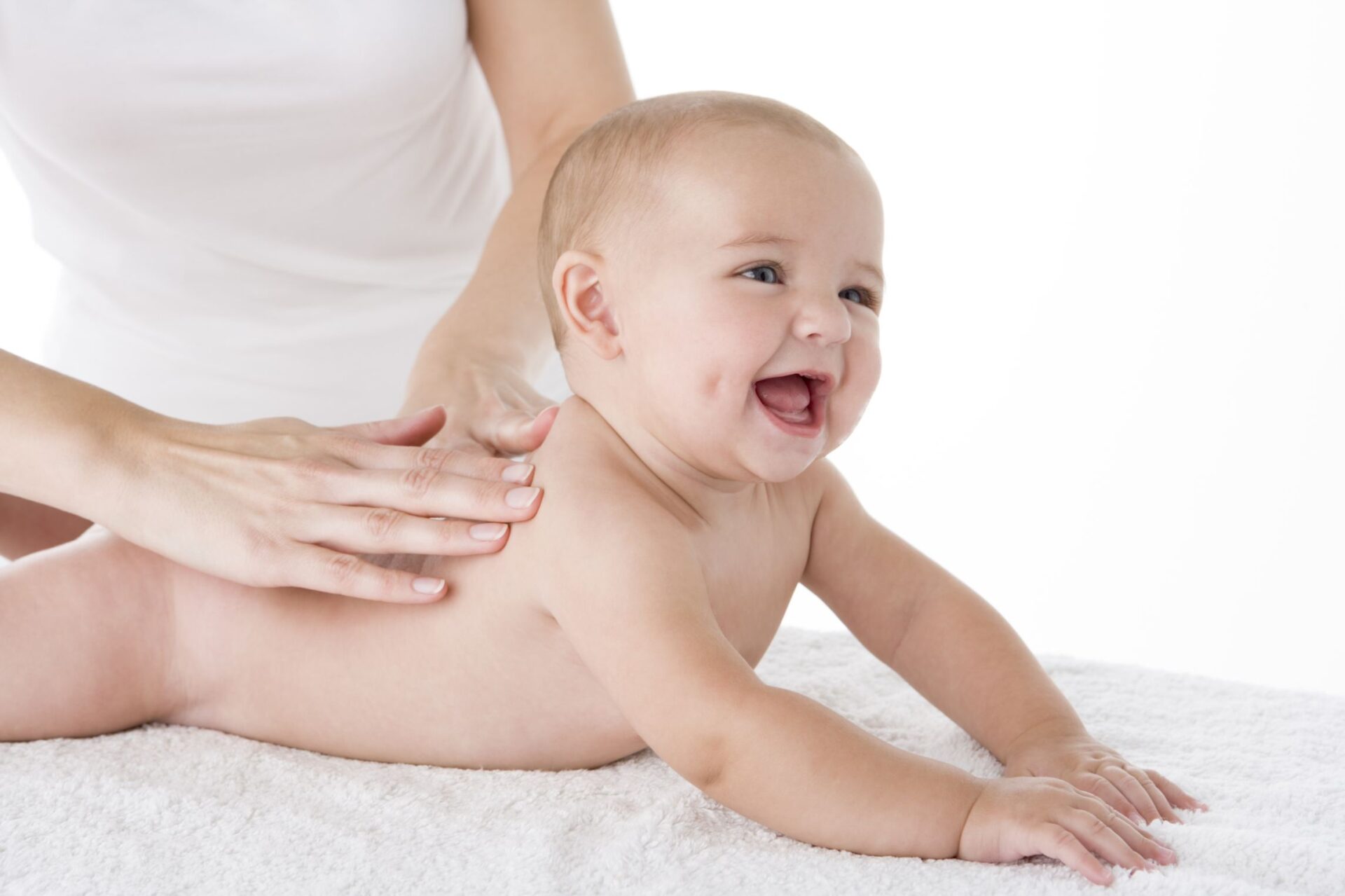
The dynamic of parent-infant interaction is the most important foundation upon which a child learns about the self, and about trust and respect. It is this first relationship that influences the way relationships are perceived. Infant massage is a natural way that parents can learn about parenting, and that infants can learn about being loved and honored.
Infant Massage is a vital, dynamic interaction that forms the foundation of relationship building that will last a lifetime. Nurturing touch between a parent/caregiver and an infant enriches physiological, social-emotional, and mind/body/spirit connections for the infant being massaged, as well as for the parent. Being touched and caressed, being massaged, is food for the infant, food as necessary as minerals, vitamins and proteins.
Touch is vital for the development of attachment behavior and for early social development of the young child, in that both the infant and parent have the capacity to elicit and respond to behaviors in mutually pleasurable ways. The original infant-parent tie is very important for infants-and society-because it is from this original attachment and bonding that all subsequent attachments will follow.
Two conditions that enhance development of bonding are the ability of the parent to be sensitive in understanding and responding to his or her infant’s cues, and the amount and nature of the interactions between infant and parent. It is through infant massage that bonding may be deepened.
Social interaction is significant for the parents’ well being, essential for the child’s development during the first three years of life, and paramount thereafter. Babies are social creatures who learn from their interactions with others. Expanding children’s repertoire of interactive behaviors can assist them to influence their world, and deepen their quality of life and the lives of their parents.
The Role of Massage with Infants
Massage is generally a technique that combines tactile, kinesthetic stimulation performed in a purposeful, sequential application. The massage technique for infants is much different from massage for adults. It is not as much manipulative as it is communicative. It is a technique that allows parents to engage and relax their child in mutually pleasurable interaction.
It is not the massage therapist or the infant massage instructor who massages the infant/child-it is the parent/caregiver. In the field of infant massage, the parent is viewed as the primary source of interaction in the context of the infant’s life. The dynamics of infant massage facilitate parenting skills, infant-parent interaction, bonding and attachment, and parents’ ability to read their babies’ cues.
Positive cues may include eye contact, smiling, looking at the parent’s face, making babbling or cooing sounds, and smooth movements of the arms and/or legs. Negative cues may include pulling away, frowning or grimacing, turning the head away, arching the back, crying, squirming, and flailing movements of the arms and/or legs. The focus of infant massage is not solely on the baby, but on the reciprocal interaction between infant and parent. Infant massage is not done to an infant; it is done with an infant.
“Touching is the first communication a baby receives,” says Frederick Leboyer, author of Loving Hands. “The first language of its development is through the skin.”
Infants communicate through their bodies. When you engage an infant in a massage, you begin to listen to the infant; you listen to sounds, you watch movements, you listen with your eyes, your ears and your heart. Infant massage, or touch communication, nurtures the most important relationship the child will ever have: the relationship between the parent and infant.
By using infant massage a parent grasps the art of listening, asking permission, communicating, interpreting and responding to cues. The infant displays engagement/disengagement cues, furthers body awareness, self-esteem, listening and communication. Both infant and parent benefit from eye contact, relaxation, bonding, synchrony, love and trust.
After learning infant massage a parent exclaimed, “I used to be frustrated not knowing what cues my baby was giving me. After learning infant massage I am a better reader of my child’s cues, and know when she is fussy because she has gas, or she is fussy because she wants to be held. I feel more confident as a mother. My husband has even learned about massage and uses it regularly as a way to become closer to our child, especially after he returns from working out of town for weeks at a time.”
For the mother of a child with cerebral palsy, infant massage has made a world of difference in her ability to open up a line of communication with her child. “My baby used to just be a baby,” she said. “Now he is a baby, and he has a personality. Infant massage gave him a way to express himself-giggling, or interacting in a dialogue when he had never been able to speak before.”
The Benefits of Infant Massage
In the Psycho-social Domain
Benefits to the infant of receiving massage:
Promotes bonding and attachment
Promotes body-mind-spirit connection
Increases self-esteem
Increases sense of love, acceptance, respect and trust
Enhances communication
Benefits to the parent of giving massage:
Improves ability to read infant cues
Improves synchrony between caregiver and infant
Promotes bonding
Increases confidence in parenting
Increases communication-verbal and non-verbal
Improves relaxation
Provides time to share, and quality time
Promotes parenting skills
In the Physiological/Physical Growth Domain
Benefits to the infant of receiving massage:
Improves body awareness
Improves relaxation and release of accumulated stress
Stimulates circulation
Strengthens digestive, circulatory and gastrointestinal systems, which can lead to weight gain
Reduces discomfort from teething, congestion, gas, colic and emotional stress
Improves muscle tone coordination
Increases elimination, circulation and respiration
Improves sleep patterns
Increases hormonal function
Benefits to the parent of giving massage:
Improves sense of well-being
Reduces blood pressure
Reduces stress
Improves overall health
The Technique and Effects on the Body
In the infant massage process, communication plays an active part. The parent talks to the infant, asks permission to start the massage, questions the infant, and facilitates dialogue. The massage process is composed of about 20 percent technique and 80 percent communication. Parents are taught by an infant massage instructor to make sure that they are relaxed both physically and mentally before they massage their baby. The instructor provides education regarding the power of touch, the importance of this sense in the development of a healthy infant or a child, and its impact on bonding and attachment.
Prior to beginning any massage, permission is asked of the infant. To do this the parent places a small amount of cold-pressed natural fruit oil or vegetable oil in the palm of one hand and rubs both palms together near the infant’s ear so that he or she may hear the sound and associate that sound with a pleasurable experience. The parent may hold up both hands with opened palms for the infant to see. Next, the parent asks, “Do you want a massage?” or “Are you ready for a massage?” A parent need only watch the infant’s body language to know whether the infant is engaging or disengaging. For infants to be massaged, they must be in a quiet alert state. If the infant does not want a massage, or is fussy and uncooperative, then another time is chosen for the massage.
